There is a week every late summer when the tomatoes win. The plants that sulked through July suddenly produce faster than anyone can eat, slice, or give away, and the kitchen counter disappears under a red avalanche. That is the moment to decide, calmly and in advance, how you want to meet the surplus. Three methods do most of the work in home kitchens: the freezer, the drying rack or oven, and the jar. They are not interchangeable. Each asks for a different kind of effort, a different piece of equipment, and a different chunk of your storage space, and each one is genuinely better than the others for certain jobs. What follows is a plain comparison, so you can choose by how you actually cook in February rather than by what looks appealing in September.
Freezing: the method that forgives almost everything
Freezing is the least demanding of the three, and for most people it should be the default. It needs no acid, no boiling water, no tested recipe, and no particular skill. Tomatoes freeze well because you are not trying to preserve texture, only flavour, and flavour survives the freezer beautifully.
For whole tomatoes, wash and core them, then spread them on a tray lined with parchment and put the tray in the freezer until they are solid. Only then bag them. This small extra step means you can pull out four tomatoes for a sauce instead of thawing a solid block of twelve. No blanching is required; the skins slip off easily under warm water once the tomatoes have thawed, and if you are cooking them down anyway, you can leave the skins on and pick them out later.
For sauce, simmer tomatoes with onion, garlic, and salt until they are as thick as you want them, cool the pot quickly, then ladle into bags set inside a measuring jug. Freeze them flat on a shelf and they stack like files. Two-cup portions suit most households. Label with the date and whether the sauce is seasoned, because an unseasoned base is more useful than you think.
The trade-off: frozen tomatoes collapse into softness. They are excellent for sauce, soup, stew, shakshuka, and braises, and useless for a salad or a sandwich. Use them within about a year for the best flavour; they stay safe far longer, but they slowly taste of nothing.
Drying: small jars, deep flavour, a lot of waiting
Drying concentrates tomatoes into something sweeter and more intense than the fresh fruit, and it does so in a fraction of the space. The catch is the yield, which surprises everyone the first time. A full tray of halved plum tomatoes reduces to a small jar you can hold in one hand.
Halve Roma or San Marzano types lengthwise, scoop out the watery seeds with a thumb, and salt them lightly. In a dehydrator, follow the machine's guidance, usually somewhere around 55–60°C. In an oven, set it as low as it will go, around 70–80°C, and prop the door open with a wooden spoon so moisture can escape. Expect six to ten hours depending on the size of the tomatoes and the humidity in your kitchen. They are ready when they are leathery and dry to the touch, with no damp spots, and bend rather than snap.
Storage needs a little thought. Dry-packed in an airtight jar in a cool, dark cupboard, they keep for several months. Covered in olive oil, they must go in the fridge and be eaten within a couple of weeks, since oil-packed vegetables stored at room temperature carry a real risk; if you want oil-packed tomatoes that last longer, freeze them in the oil instead. Follow tested guidance if you plan to store them any other way. A few chopped pieces stirred into a winter pasta, a frittata, or a bowl of white beans will remind you why you bothered.
Jarring: the morning's work that fills the pantry
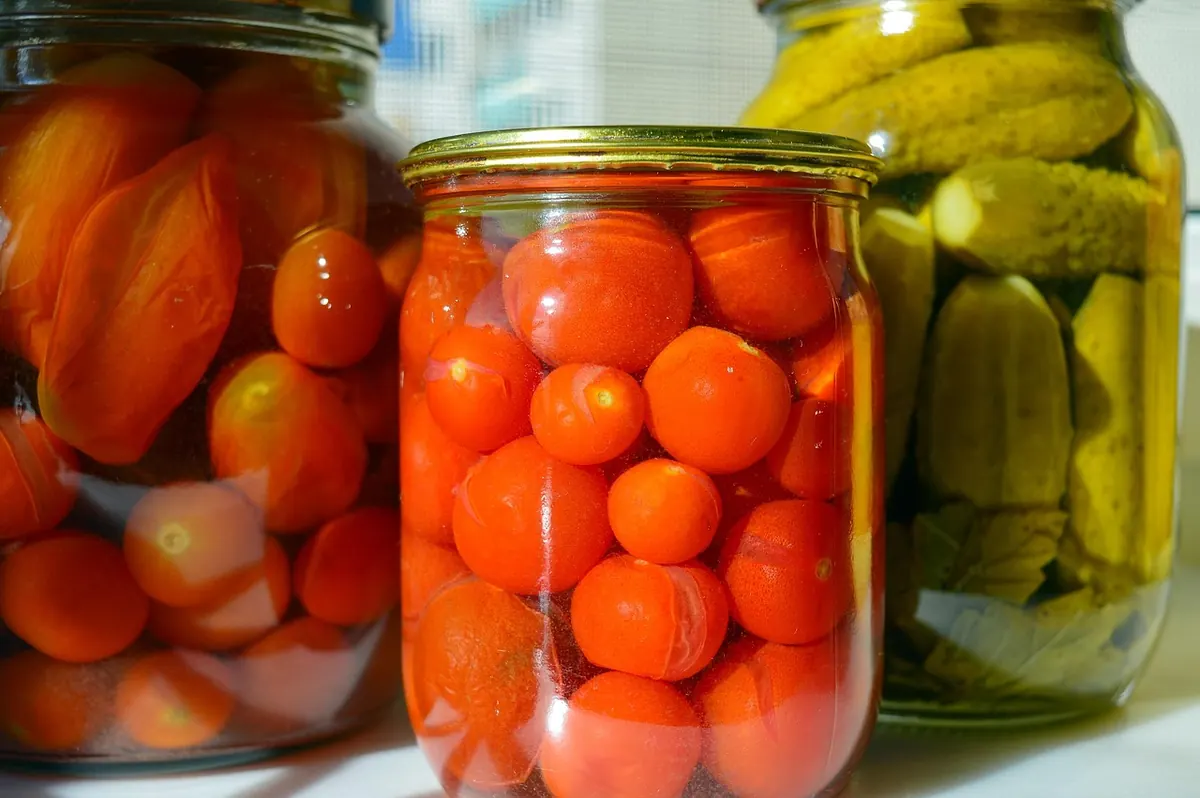
Jarring — bottling passata, whole peeled tomatoes, or sauce in a boiling water bath — is the most demanding method and the most satisfying to look at afterwards. It is also the only one where the process matters for safety, not just quality, because tomatoes sit close to the acidity line where bacteria stop being inhibited.
The essentials are simple and worth learning properly:
- Use a tested recipe from a reliable preserve source, and follow its acid addition — usually bottled lemon juice or citric acid — rather than improvising.
- Pack hot jars with the headspace the recipe specifies, run a thin spatula around the inside to release trapped air, wipe the rims, and seal.
- Lower the jars into a pot with a rack, cover by an inch or two of water, and start timing only once the water returns to a full boil.
- Use the time given for your jar size and altitude, then rest the jars for five minutes before lifting them out.
- Cool undisturbed for twelve to twenty-four hours, check that every lid has sealed, and label with contents and date.
Store jars in a cool, dark place and use them within a year. Before opening, press the lid: it should be firm and concave. If it flexes, or the contents smell or look wrong when opened, throw them out without tasting. The cost of being wrong here is not worth the jar.
Compared side by side
- Effort: Freezing is a twenty-minute job once the tomatoes are clean. Drying is mostly waiting, with a little checking. Jarring is an afternoon, and it needs you present at the stove.
- Equipment: Freezing needs bags, trays, and freezer room. Drying needs a dehydrator or a patient oven. Jarring needs jars, new lids, a deep pot, a rack, and jar tongs.
- Storage space: Drying wins by a wide margin; a season's worth fits on one shelf. Jars take real cupboard space but no electricity. Freezing is the hungriest, especially if you freeze whole tomatoes on trays.
- Best uses: Frozen tomatoes for long-cooked sauces, soups, and stews. Dried tomatoes for pasta, salads, focaccia, and anything that benefits from a savoury punch. Jarred tomatoes for the dishes where you want the taste of summer straight from the cupboard — a quick tomato pasta, a pizza base, a bowl of beans.
- Weak point: Freezing depends on power and space. Drying gives you small quantities. Jarring demands attention and a little study.
Matching the method to your kitchen
If your freezer is already full, jarring is the answer, provided you have a free morning and a pot deep enough. If you cook tomato sauces weekly through the winter, freezing in flat bags will pay you back on every weeknight. If you love intense flavours and have more shelf space than freezer space, dry a few trays and see how fast the little jars disappear. Many households do two: freeze the bulk, dry a tray for the treat.
Before you start, three small habits
Wash and dry your jars and lids before anything else, and have them hot and ready before the tomatoes are. Write the date and the contents on every bag and lid — you will not remember in March, and a mystery jar is a wasted jar. And taste as you go: a sauce that is bland before freezing will be bland after thawing, so salt and reduce it properly first. Preserving is only ever as good as what you put in.
Photo: AKuptsova / Pixabay